






TRIPS
 About us
 Contact
 Travel searcher
 Subscribe to newsletter
Top Arctic World Expeditions

Recommended video

Outstanding News
Travel Map

IPGA Association

Specialists in Iceland

600 km of unprecedented ski route on the great Arctic Island of Ellesmere


600 km of unprecedented ski route on the great Arctic Island of Ellesmere
The expedition
On May 17, 2026, Jose Naranjo from the Canary Islands (Spain) and Ingrid Orlieb, a German woman living in Spain, completed a groundbreaking ski route of over 600 km after a 42-day expedition completely self-sufficient and unsupported, they traversed several remote fjords, including the two largest fjords on the Arctic island of Ellesmere.
On May 17, 2026, Jose Naranjo from the Canary Islands (Spain) and Ingrid Orlieb, a German woman living in Spain, completed a groundbreaking ski route of over 600 km after a 42-day expedition completely self-sufficient and unsupported, they traversed several remote fjords, including the two largest fjords on the Arctic island of Ellesmere.
They are possibly the first people to ski all the way through those two great fjords.
---------------------------------------------------
Ellesmere
Ellesmere is an island in Nunavut, Canada, located just 800 km from the very Geographic North Pole. With 196,000 km², it is the tenth largest island in the world and the fourth largest in the Arctic. The distance from Ellesmere from south to north is about 840 km, roughly the straight-line distance between Paris and Berlin. And our expedition was going to take place in what is considered the coldest region in all of Canada.
---------------------------------------------------
An expedition within an expedition
The expedition began on April 6th at the southern end of Canyon Fjord, but to get there, we first had to undertake a snowmobile route of over 700 km, the equivalent of crossing Belgium, the Netherlands, parts of Germany and Denmark, but through narrow frozen fjords, glaciers, snowy tundra, Arctic rivers of pure ice, and treacherous ice floes. In short, we had to complete a true Arctic expedition just to reach the starting point of our ski expedition.
Our Inuit friends, Terry, Nolan, Silas, and Abraham, four young men from Grise Fjord, the northernmost town in Canada, took us by snowmobile from that small town to Slire Fjord after five days of extreme cold, with temperatures reaching -40°C, and numerous hardships.
---------------------------------------------------
Arrival at Cañon fjord
From that small fjord, Terry and Nolan led us by snowmobile to the glacial front of Cañon Fjord after a grueling journey. First, we crossed the harsh tundra of the Folsheim Peninsula, which they had never even seen, and then we reached Cañon Fjord, where they had never been and didn't know anyone who had. In Terry's words, this fjord was very, very remote. So remote and hidden that they were surprised there were no animal tracks along the nearly 100 km we covered that day on the snowmobiles.
----------------------------------------------------
Cañon fjord
Once our Inuit friends left, we were alone in Cañon Fjord, named after a Spanish word that is the official Canadian name for this fjord and its namesake glacier.
---------------------------------------------------
The Cañon - D'Iberville - Greely route
During the ski expedition, we traversed the entire length of Cañon Fjord, from the glacier front of the same name in the south to its confluence with Greely Fjord in the north. We were possibly the first people to ski this fjord for its longest distance.
Next, we ventured into D'Iberville Fjord and skied to its end, where the glacier front of the same name rests. Days later, we headed to Antoinette Bay with its gentle glacier front and its "fierce" companion, the glacier of Lake Tuborg, both of which mark the end of Greely Fjord.
From there, we returned along the northern coast of the Greely Fjord to ski its entire length, possibly becoming the first people to ski it completely.
--------------------------------------------------
The route Greely fjord - Nansen Sound - Fosheim peninsula
Once at the foot of the imposing mountain known as Black Stripe Head, named for its distinctive, straight band of black rock that marks the westernmost boundary of the Greely Fjord, we crossed it towards the northwestern tip of the Fosheim Peninsula.
This crossing of the icy sea was quite deceptive due to a violent wind that appeared and disappeared, blowing from the Nansen Strait directly from the Arctic Ocean.
--------------------------------------------------
Skiing
Our route flanked hundreds of vertiginous mountains that plunged directly into the fjord, mountains never before climbed, never before named.
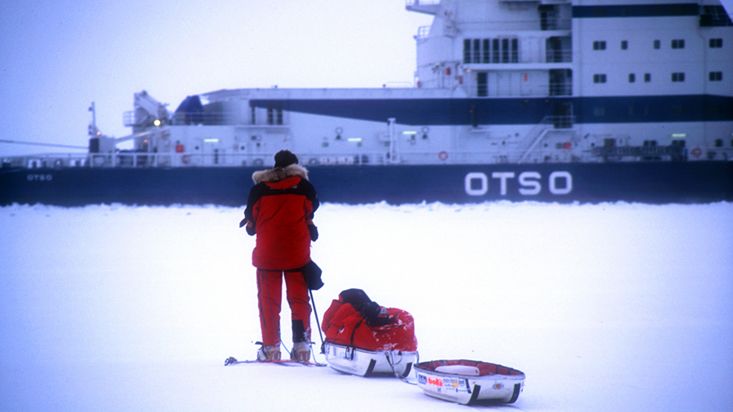
We were like metronomes on skis, pulling our sleds that initially weighed over 90 kg. We didn't push ourselves to the limit in areas of tricky ice or deep snow, nor did we try to go faster when the ice was flat and slippery. To use classical music terms, we went "andante" in bad conditions and "allegro man no troppo" in good conditions. The goal: to finish the day without being exhausted and to be able to enjoy the beauty of an environment as harsh as it was ethereal.
---------------------------------------------------
Canis Lupus Arctos
In the silence of this white world, encountering an Arctic wolf in the middle of nowhere is an almost mystical experience. And so it happened; suddenly, it was beside us. One of those moments when the icy landscape seems to stand evn more still, and one can admire the penetrating gaze of this majestic animal. The Arctic had captivated us once again. The wolf is not a monster from a fairy tale; it is the very essence of winter in the Arctic. It was a magical moment. A second wolf remained on the sidelines, curious but at a distance. It wasn't the last time we encountered the Arctic wolf. As we left Antoinette Bay and looked back wistfully one last time, there it was, watching us depart. Perhaps it was its way of saying goodbye, silent yet imposing, with its white fur, its inner strength, and the freedom of the Arctic, its home.
------------------------------
End of the ski expedition
In this vast territory, first explored primarily by the renowned Norwegian explorer Otto Sverdrup and his companions at the end of the 19th century, we reached the end of our ski expedition: the camp of our friend Inuk Terry. It was May 17th, the very day of the Norwegian Constitution. A small coincidence of fate…
The expedition lasted 42 days, but we actually skied for 35 days, as we spent 7 days exploring the Cañon, D’Iberville and Antoinette glaciers.
It's astonishing that in a time when humanity wants to return to the Moon and land on Mars, two people can travel over 600 km on Earth and spend almost a month and a half without seeing another human or anything human-made.
Share this page in social networks


Do you like?